
Why are women defining Iran’s protest movement?
By: Onara Perera
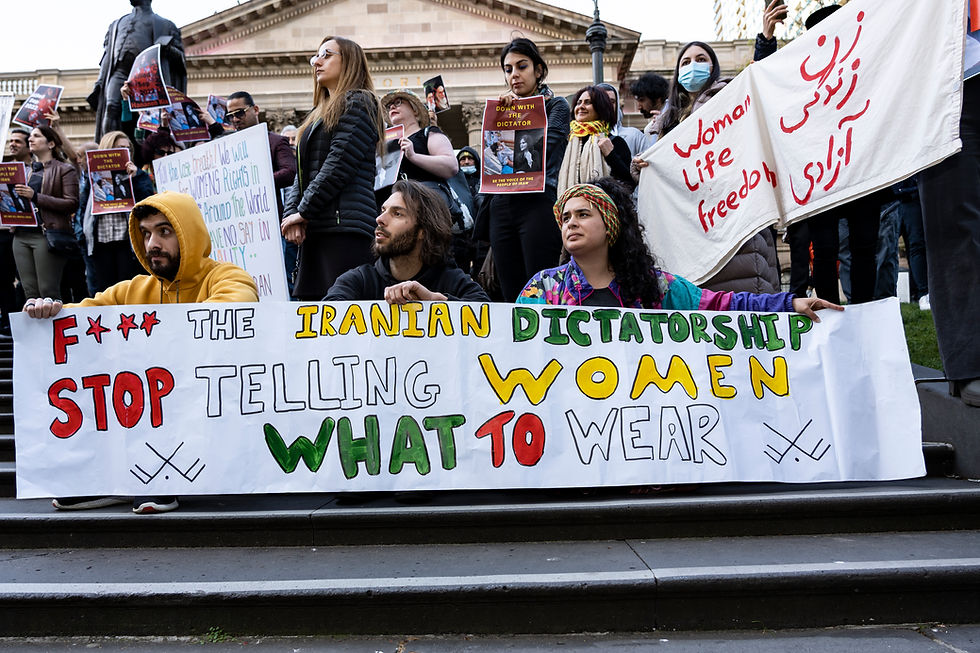
In Shahrekord, a young woman stands alone before a water cannon, arms at her sides, unflinching. In Mashhad, teenage girls form the majority of demonstrators, their voices rising above tear gas with chants of "Death to the Dictator." In Tehran's Naziabad district, a woman holds a handwritten sign that reads simply: "I am not a rioter."
The are scenes from the streets of Iran after a month of extensive and violent protests against the Iranian Regime. Iran’s women were the Islamic Republic’s first target for repression. From the earliest days after the 1979 revolution, when compulsory veiling laws were imposed and female judges were removed from their positions, to the decades of legal and social restrictions that followed, which ultimately limited women’s autonomy in matters of clothing, employment, travel, marriage, and divorce.
Women became symbols of ideological control, and regulating women became a visible means through which the state asserted political authority.
To understand the heavy involvement of women in recent protests, we must first understand the tipping point in 2022. For decades, resistance simmered quietly beneath the surface of Iranian society. It appeared in subtle acts of defiance, in private frustration and in periodic but contained demonstrations. Many women pushed boundaries in everyday life by loosening headscarves, entering professions once closed to them, and demanding greater legal protections. Yet the system of control remained firmly in place.
That simmering discontent erupted in September 2022 with the death of Mahsa Amini, who was arrested by the country’s morality policy for allegedly violating compulsory hijab laws and later died in a coma after facing torture and other ill-treatment inside the police van, including through beatings to her head. Her death quickly became a national flashpoint. For many Iranians, it confirmed what they had long believed about the state’s enforcement of discriminatory laws and its willingness to use force in the name of ideological control.
What followed was not simply outrage over a single tragedy, but a wave of accumulated anger.
Women removed their headscarves in public, shaved their heads in protest, and took to the streets in unprecedented numbers. The slogan “Woman, Life, Freedom” became the defining call of a movement that extended far beyond dress codes to challenge the broader authority of the Islamic Republic. These nationwide protests were met with widespread human rights violations by the Iranian authorities which included unlawful killings, executions, mass arrests, torture, including rape of detainees, and harassment of victims’ families who called for truth and justice.
International tensions add another layer of complexity to these protests. As the United States increases its military presence in the region, the future of Iran’s protest movement becomes entangled with the risk of external escalation. Recent analysis suggests Washington now appears ‘poised to strike Iran’, assembling ‘more air power in the region than at any time since the 2003 invasion of Iraq.’ While this might be designed to pressure Tehran, if negotiations fail and military action follows, the consequences are unpredictable. A more effective response from the United States would involve targeted sanctions against officials responsible for human rights abuses, coordinated diplomatic pressure with allies, and support for secure communication tools that allow Iranian citizens to document events safely.
There is no simple external solution to Iran’s unrest. Sustainable change must ultimately emerge from within Iranian society.
What the international community can do is avoid undermining the organic legitimacy of the movement while holding perpetrators of abuses accountable.
For Iranian women leading protests, such escalation carries enormous risk. Foreign military intervention could reinforce the regime’s claim that dissent is externally orchestrated, undermining the organic legitimacy of a movement rooted in demands for dignity and self-determination. Their struggle is fundamentally domestic. If it becomes subsumed by geopolitical confrontation, the voices of women at the heart of the uprising risk being overshadowed by war.
Thus, it is convincing to state that women are defining Iran’s protest movement because their oppression has long been central to the identity and enforcement mechanisms of the Islamic Republic. In Iran, the regulation of women’s dress, mobility and legal rights has symbolised state authority for decades. When women publicly remove their headscarves, lead chants and stand at the front of demonstrations, they are not only protesting individual injustices but directly challenging the ideological foundations of the regime.
Their struggle resonates widely because it represents a broader demand for dignity, accountability and political freedom.
Whether these protests will lead to regime change remains uncertain. The state retains significant coercive power and has demonstrated its willingness to use force. While sustained civil resistance can gradually weaken authoritarian systems, abrupt collapse is unlikely in the short term. Ultimately, lasting change must come from within Iranian society. The international community’s role should be to support, not overshadow, a movement whose legitimacy rests on the courage of its own people, especially its women.
Image: Wikimedia Commons
Comments